A depression within a bull.
Semiconductor shares and reported accelerator sales have travelled almost the same distance in opposite directions. Replay every session, then test the dot-com comparison against the earnings.
Research archive · 82 publications
AI changes how work gets done, what infrastructure earns, and what markets pay for it. Follow the evidence through the original research and the published conversations.
Semiconductor shares and reported accelerator sales have travelled almost the same distance in opposite directions. Replay every session, then test the dot-com comparison against the earnings.
A mathematician and Claude announced a formal argument about the Riemann hypothesis. A proof checker can test the artifact independently of the model. The harder human task is establishing that the statement and assumptions mean what the authors claim.
Cisco and NVIDIA had each lost nearly 48% in the historical comparison. A dollar of trailing earnings cost about $102 at Cisco and under $14 at NVIDIA on the respective measurement dates. Matching drawdowns can conceal radically different starting economics.
The share of revenue attributed to Anthropic’s five largest customers fell from 36% to 21% as their spending reached a new high. A customer concentration metric and a measure of access answer different questions.
A hundred agents need 1 GiB each over one 400 Gb/s link. Agent 95 waits at least 2.04 seconds before GPU work resumes. Mistral and vLLM’s measurements show how host memory and sparse retrieval change the economics of that wait.
Anthropic’s IPO put a different kind of compounding in view. When a model contributes to the research that builds its successor, improvements also change the economics of producing the next model.
Commitments to suppliers for the same FY2028 rose from $87bn to $203bn. Neocloud commitments fell. The investor debate about whom NVIDIA would finance missed the change in what NVIDIA had to buy.
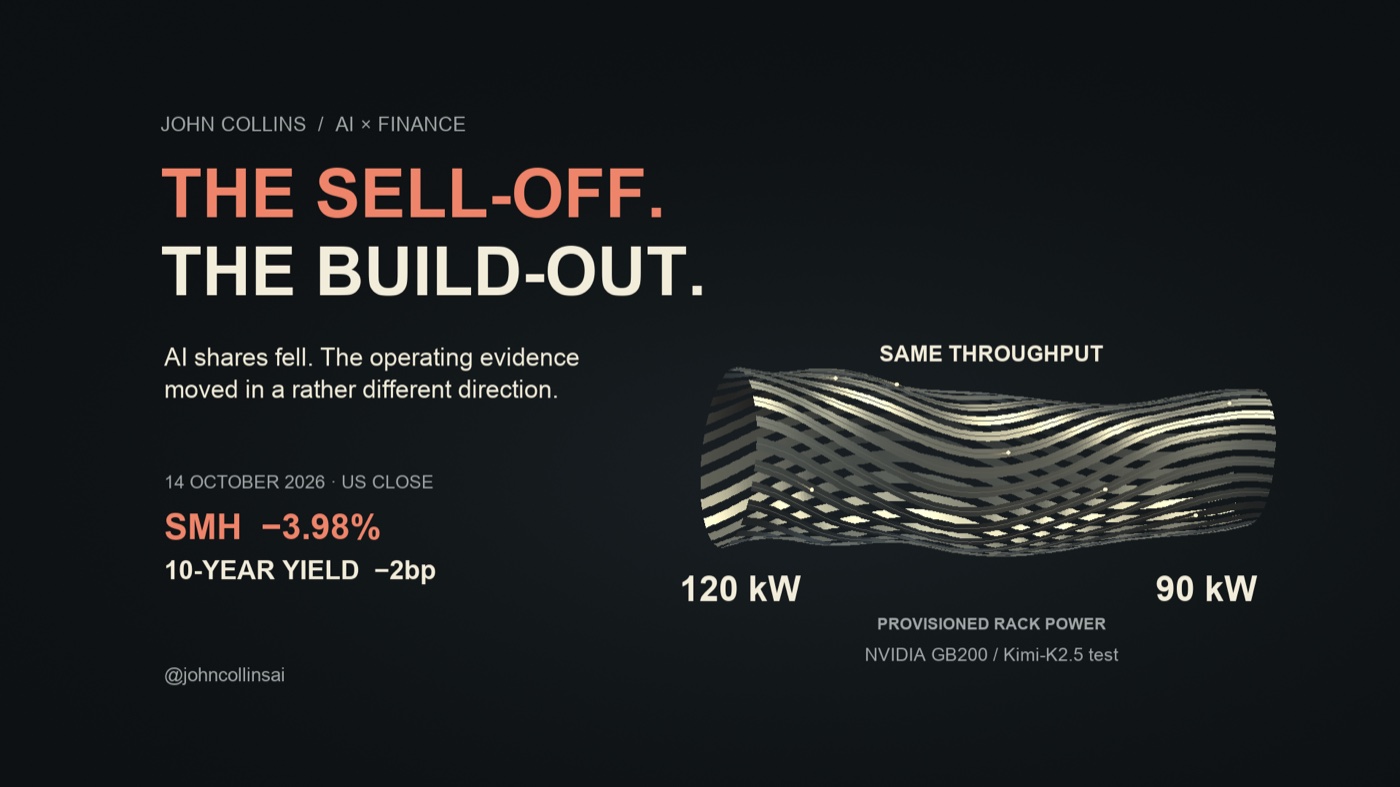
Two equity drawdowns looked familiar. Their operating evidence differed. Compare the semiconductor index, the wider market, and the sequential movement in industry sales before calling the price path a repeat of 2022.
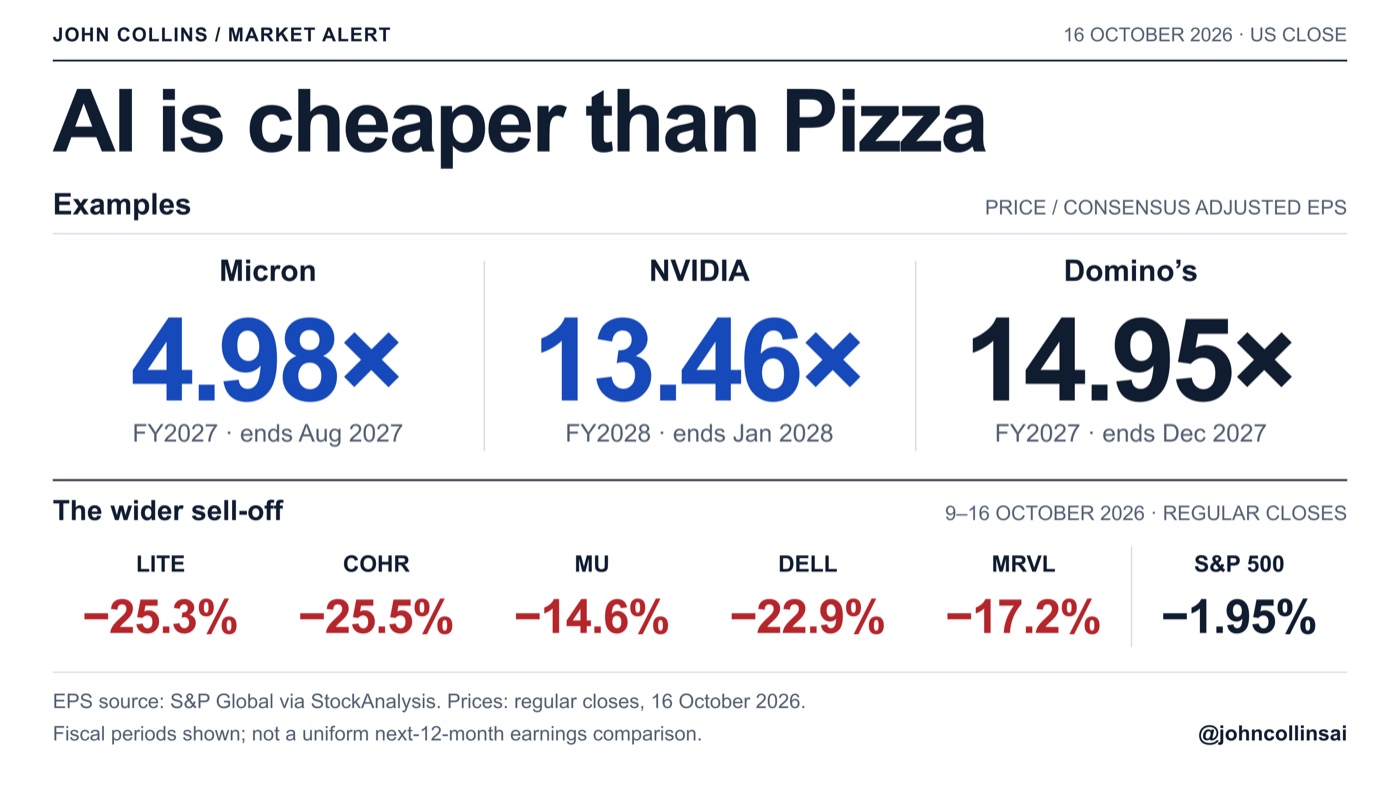
Lululemon traded at 11.2 times forward earnings in the comparison, against 4.4 for Micron and 3.9 for Sandisk. The question is how much earnings durability these prices assign to memory suppliers with multiyear contracts.
The argument that NVIDIA must finance the AI build-out needs a denominator. Compare supplier investments with the funds supplied by operators, customers and financing markets, and separate cash paid from future commitments.
Anthropic described bringing Claude up on AMD hardware. The distinction between first bring-up and a mature production fleet matters. The ability to work across architectures changes who can coordinate the next generation of AI factories.
Jensen Huang linked a supply chain, customer financing and an open-source ecosystem. SemiAnalysis’s question about succession reaches much further than who designs the next accelerator.
CoreWeave sells software to customers who already own infrastructure. Its Forge adoption and a deployment at Wayve complicate any attempt to map an equity rotation into software onto what buyers actually purchase.
CoreWeave’s first contract can service the debt on a cluster. A later customer can rent the paid-off equipment. The economics of that second contract explain why gross capex alone misses a source of capital for the next build.
A banking example exposes the cost of controlling autonomous work. Stopping the model leaves a separate problem when its payment instruction has already reached another system. Monitoring the models itself consumes compute.
Goldman’s financing activity puts a different question to local opponents of data centres. If the customer still wants compute, a blocked project can shift the investment, power purchases and jobs to another jurisdiction.
OpenAI CFO Sarah Friar described enterprise business doubling in Q3, broader deployment at Uber and 1.2 billion weekly ChatGPT users. Adoption, deployment depth and new revenue lines give three different tests of a supposed peak.
The semiconductor index fell 12.25% in a session. Five trading days took a five-year SOXL holding from $173 to $69 per $100 originally invested. Daily leverage and the path of returns explain how a holder could lose money while the unlevered index was up sharply.
Compare the four hyperscalers’ late-October equity losses with their September-quarter capital payments and company-level shortfalls after operating cash. The three numbers measure different things.
A poll divides investors almost down the middle. The relevant question for a builder is which work became economically possible when agents crossed a capability threshold.
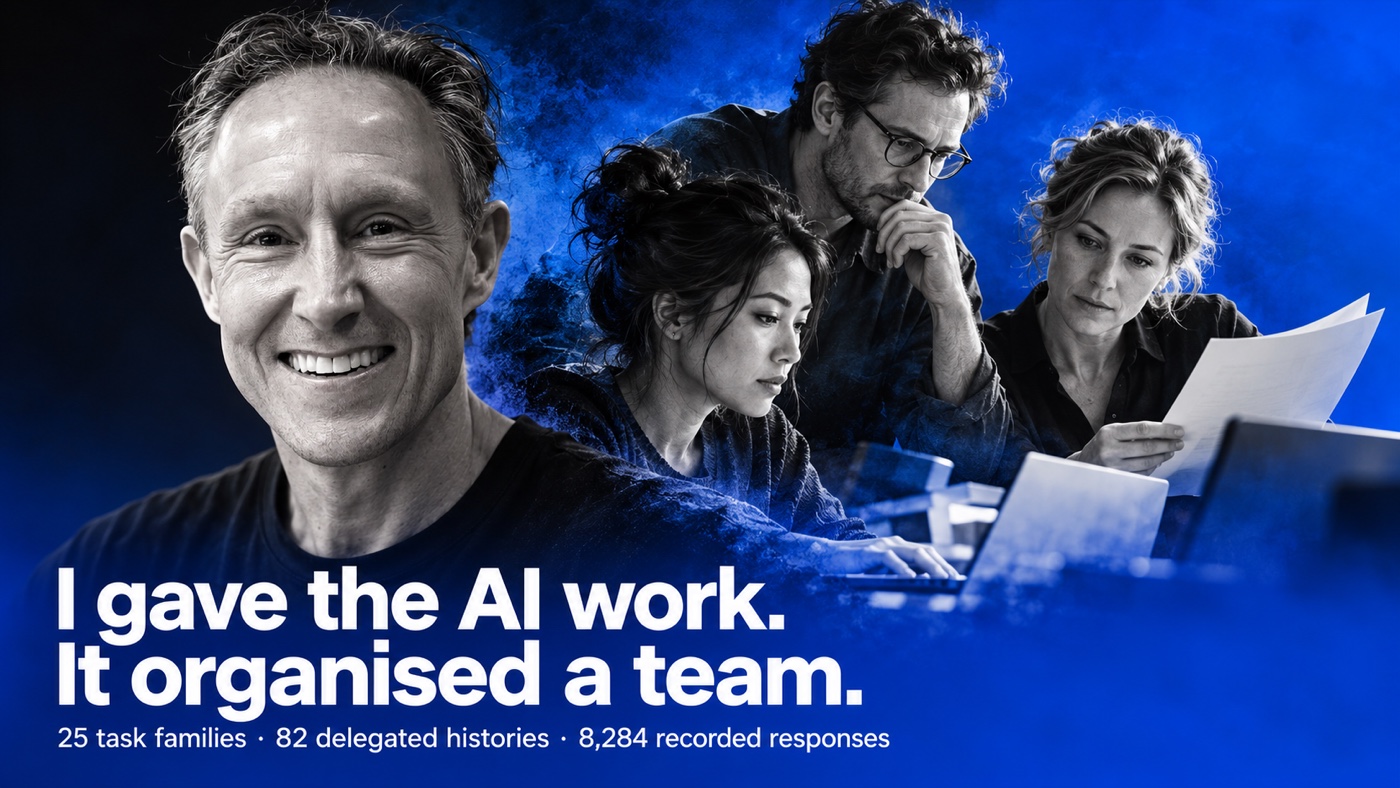
An audit of one research machine shows agents organising substantial delegated work around objectives. What that changes about knowledge work, and the memory needed to keep it running.
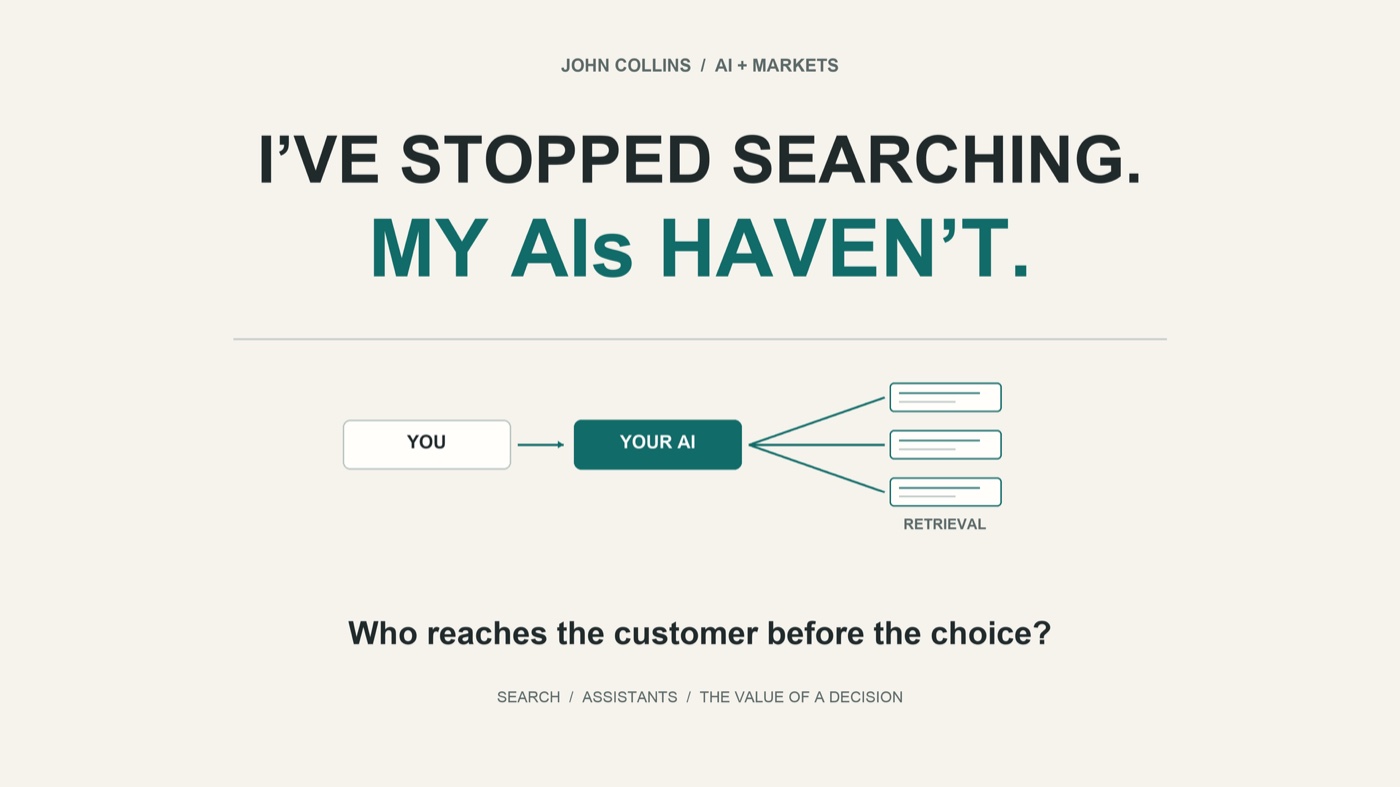
Agents still search, but the human no longer has to visit the search engine. The commercial question is who controls the decision, and who gets paid when it is made.
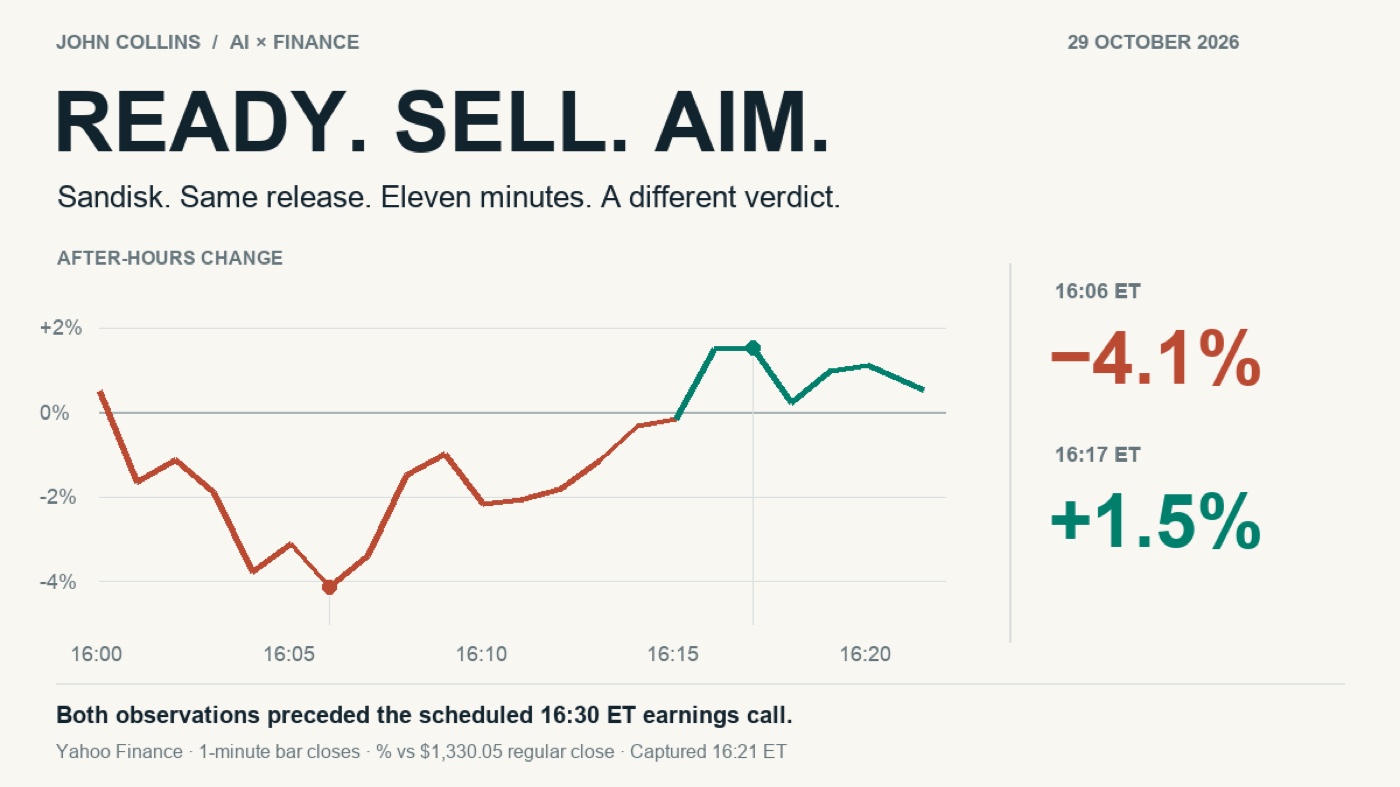
Sandisk’s after-hours reversal before its earnings call puts a short investment horizon beside multiyear commercial commitments. Separate the tape from what companies actually reported.
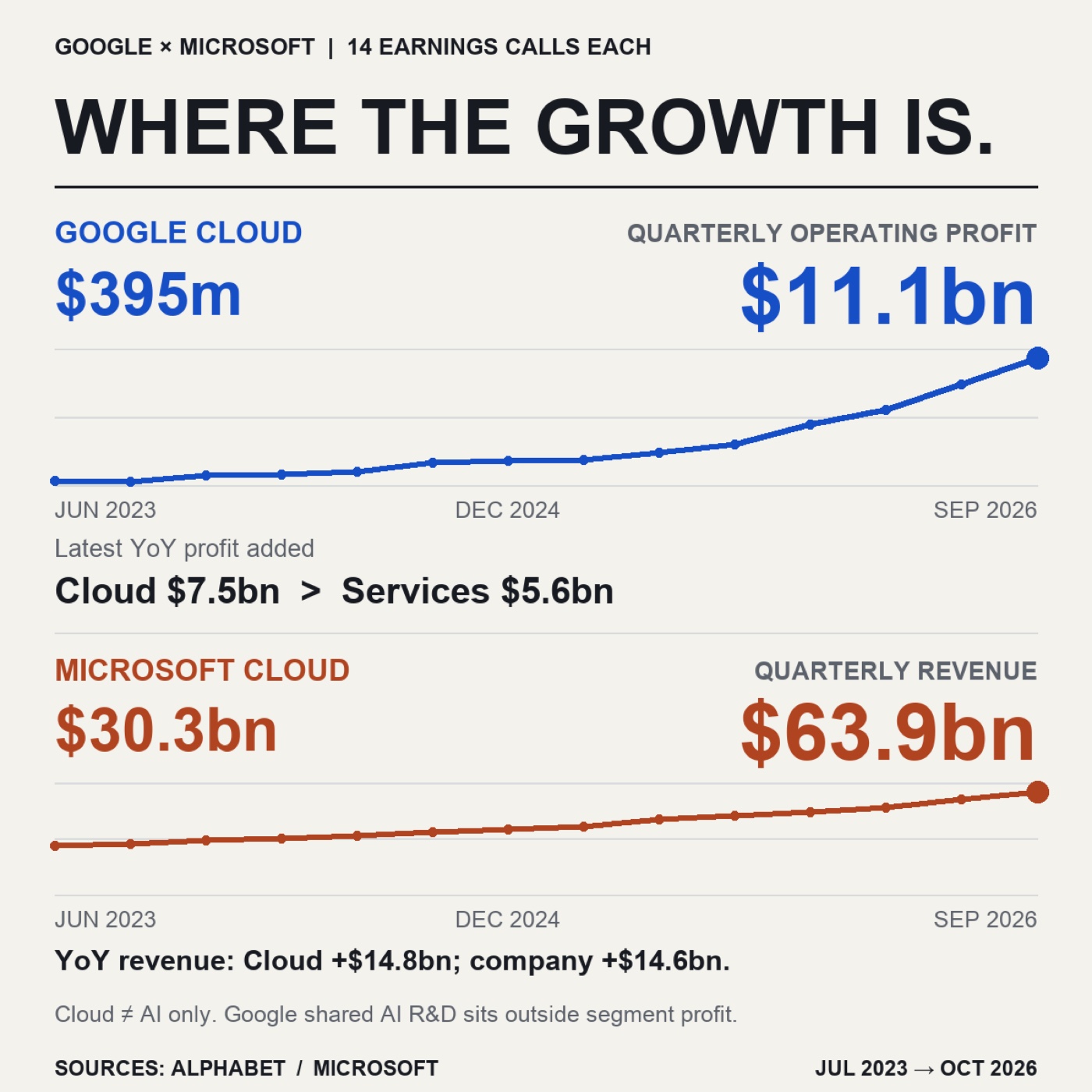
Fourteen announcements trace a change in where Alphabet and Microsoft earn their growth. The figures are cloud, not pure AI, but the implications for knowledge work are substantial.
A short recommendation of Jacob’s account of building a company around persistent agents: how work is organised, decisions are made and where humans are needed.
On Anthropic’s S-1 day, BlackRock’s Rick Rieder was putting capital into AI financing deals: a practical response to capex anxiety.
Stacy Rasgon’s modelling example suggests a practical experiment: reconstruct the history independently, then use the differences to challenge assumptions carried forward for years.
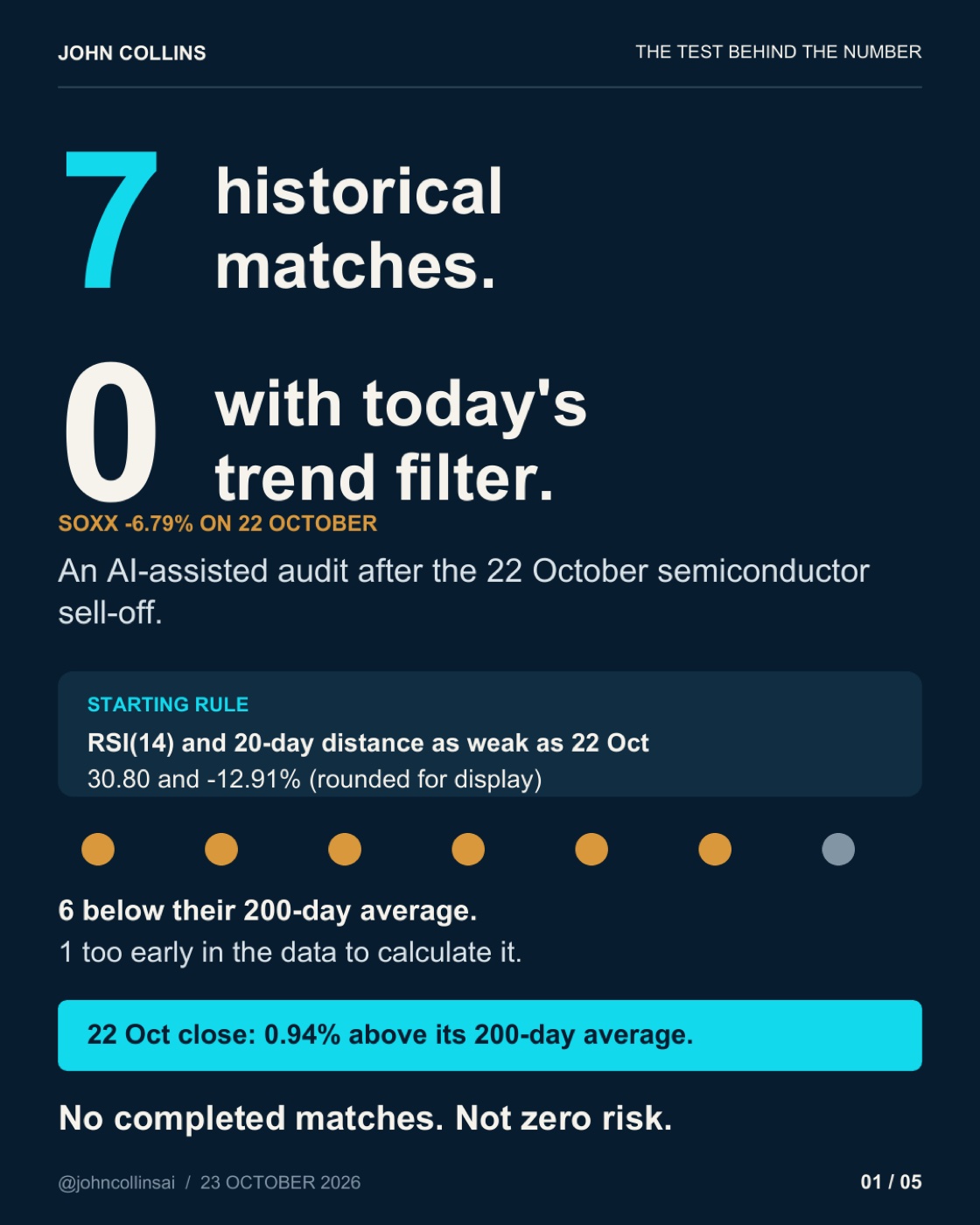
A market calculation found seven historical matches. Changing one relevant comparison left none. The useful test for AI is whether it can reproduce the result and challenge the assumptions.
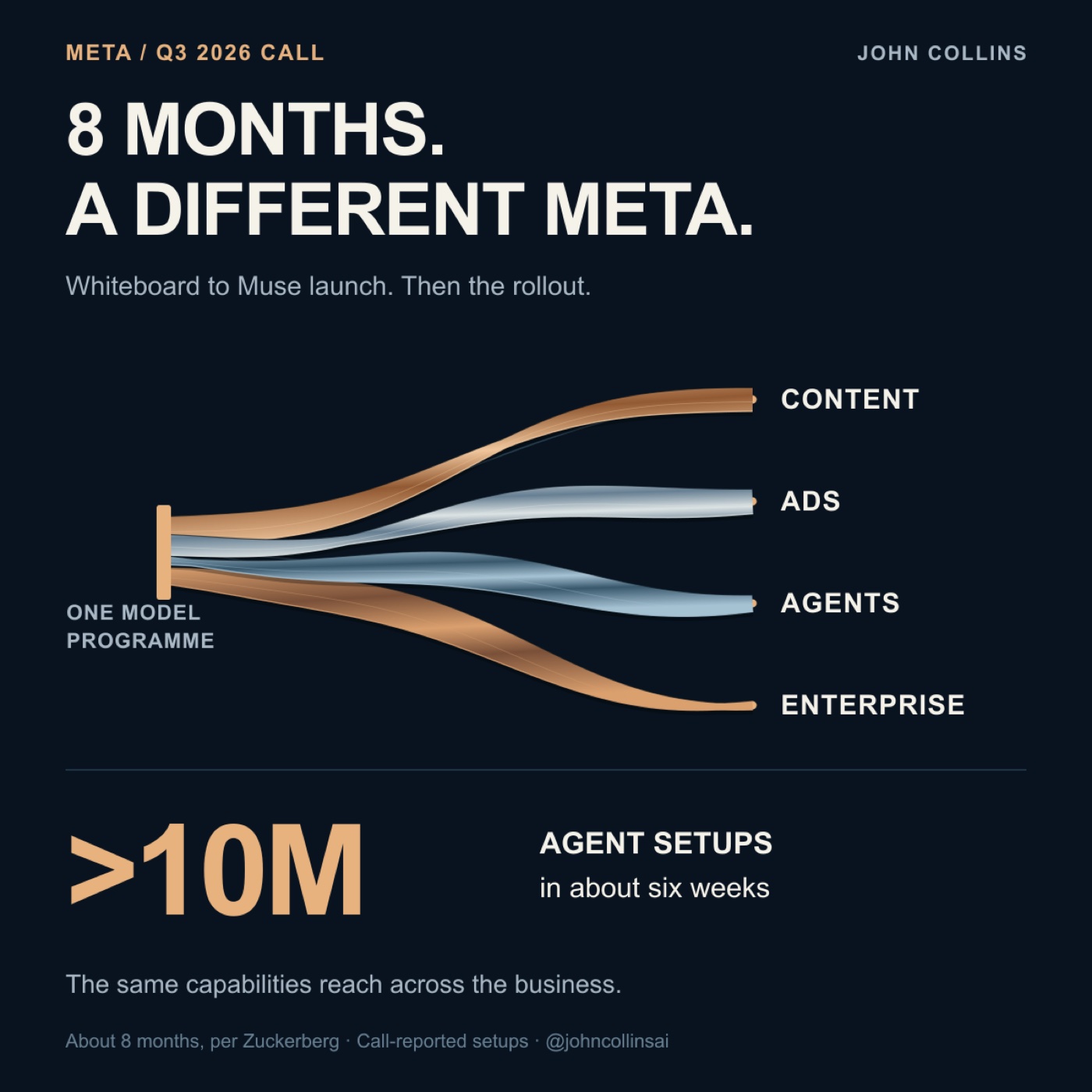
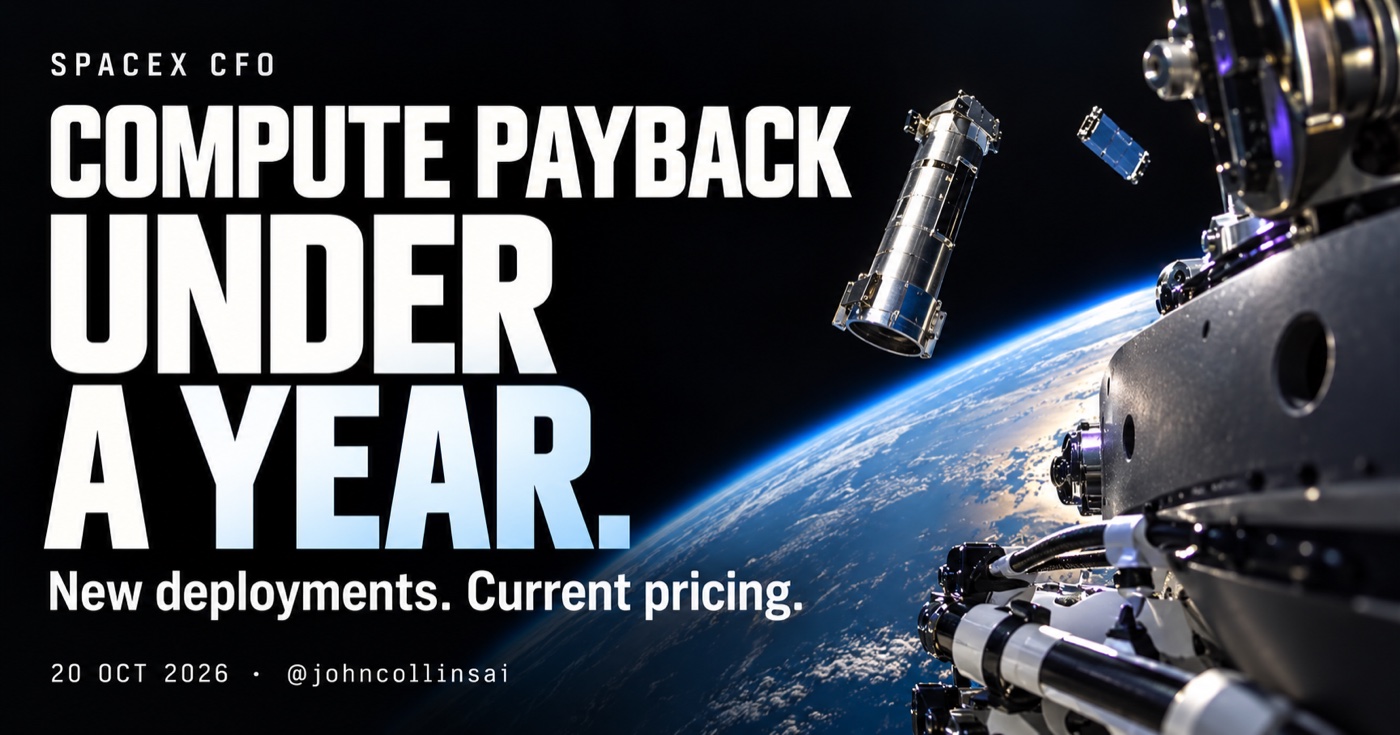
Meta and SpaceX show compute doing two jobs: helping teams create new products, then running what customers use. The relevant capex question changes when the business can create new capability as well as serve existing demand.
Compute payback disclosures make an important distinction between capacity that costs money and capacity already earning it.
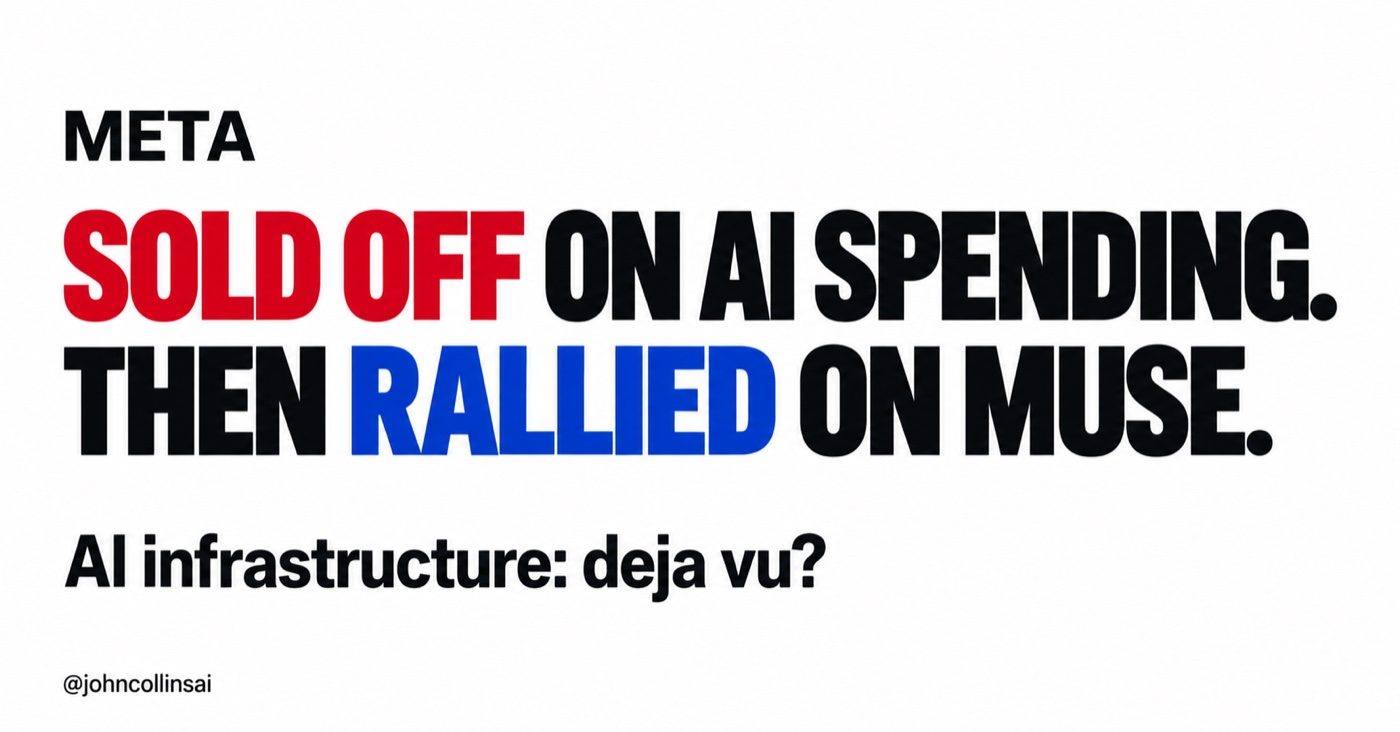
Meta and Anthropic expose two sides of the same investment question: spending can create new capability, while constrained capacity can limit the revenue used to judge that spending.
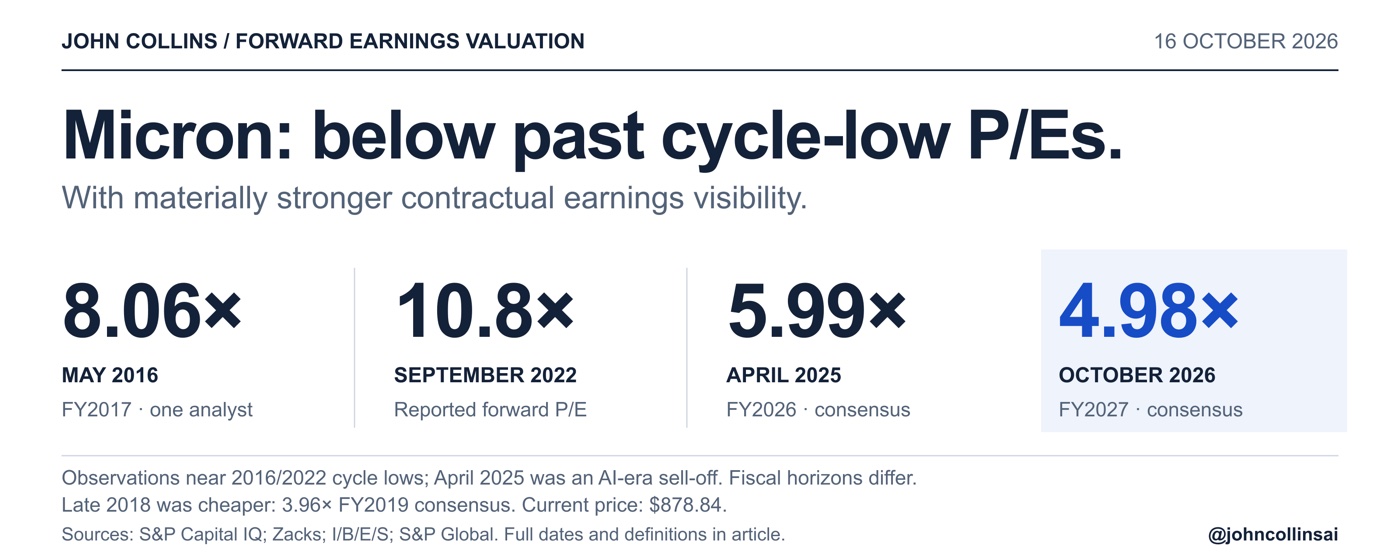
Micron’s valuation sits below most historical memory-cycle lows, alongside a different cash and contract picture. Late 2018 is the important exception.
A dated comparison of AI-infrastructure valuations with familiar consumer businesses, after a violent sell-off.
Semtech connects lower-power optical engineering with higher supplier value and operating cash. Its turnaround shows why the funding discussion also needs to examine businesses already generating money from the build-out.
NVIDIA regained a previous share-price high after its business had grown substantially. A look at what a long trading range can conceal.
Compare AI financing with hedge-fund leverage: collateral, cash flows and the speed at which funding can come under pressure.
Compare the market’s financing narrative with reported earnings, actual debt terms and the systems being developed at OCP.
Disclosures from five banks show how a small group can build systems that benefit far more people than ever touch a frontier model. Some productivity gains improve the systems needed for the next round of adoption.
Less dependence on packaged software can come with much greater infrastructure use. Jane Street and data-centre forecasts make that transition concrete.
An index bull market can contain a severe semiconductor drawdown. Examine what kept earning through it.
The build-out looks different when historical analogies are tested against earnings data and the economics of using AI.
A robot’s intervention and reset costs matter as much as the demonstration. Whether experience reduces those costs changes the economics.
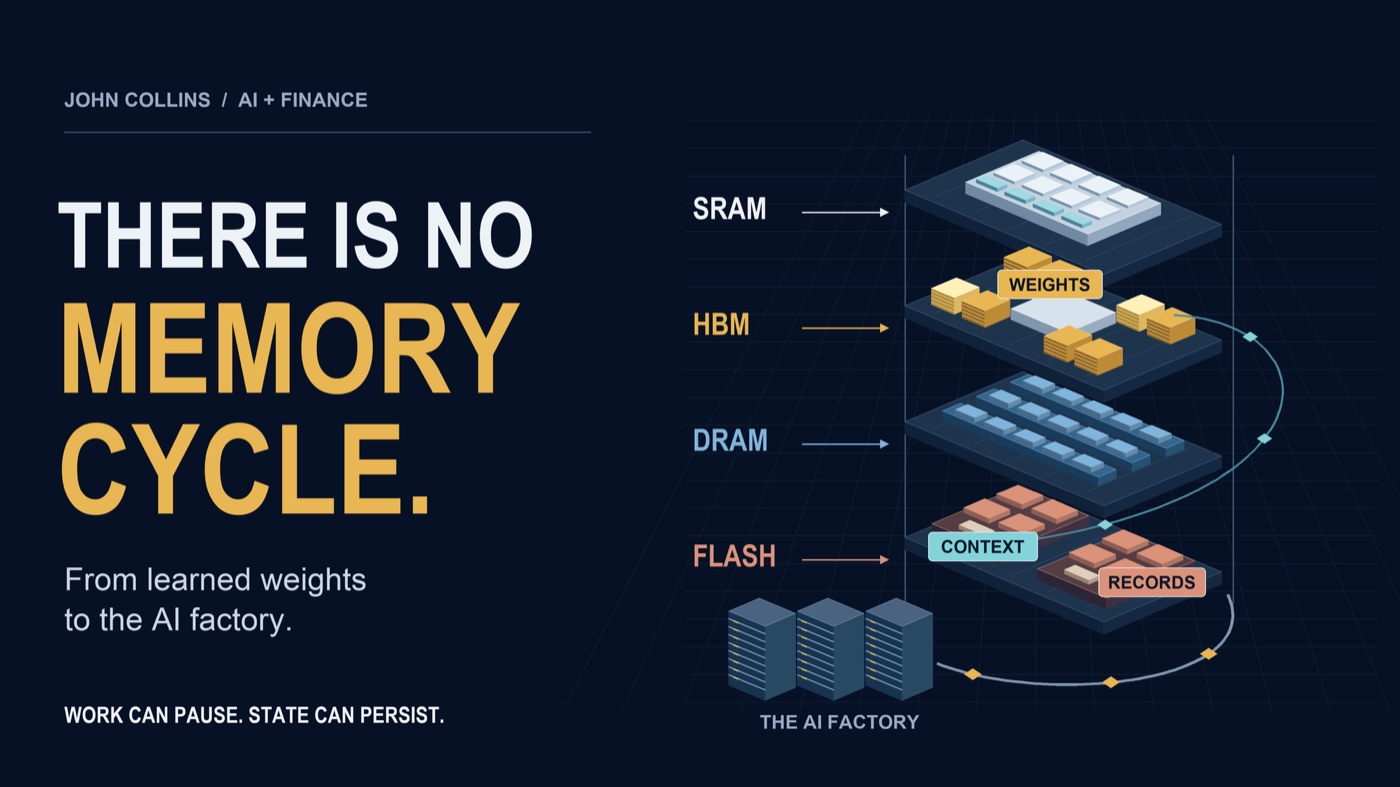
Following workloads through the rack exposes memory’s central role in context, concurrency and persistent agents.
Lumentum’s longer customer commitments shift attention from the daily revenue argument to future capacity decisions.
Local and cloud inference change the cost of keeping context, moving data and completing the next step of work.
Custom compute and multiple kinds of connectivity put Marvell across the dependencies of heterogeneous AI systems.
An audit of model calls separates reusable context from the compute saved by caching—and challenges a CPU-only interpretation of agents.
A Treasury move is not a complete funding model. Cash generation, customer advances and contractual commitments alter the mechanism through which rates reach an AI business.
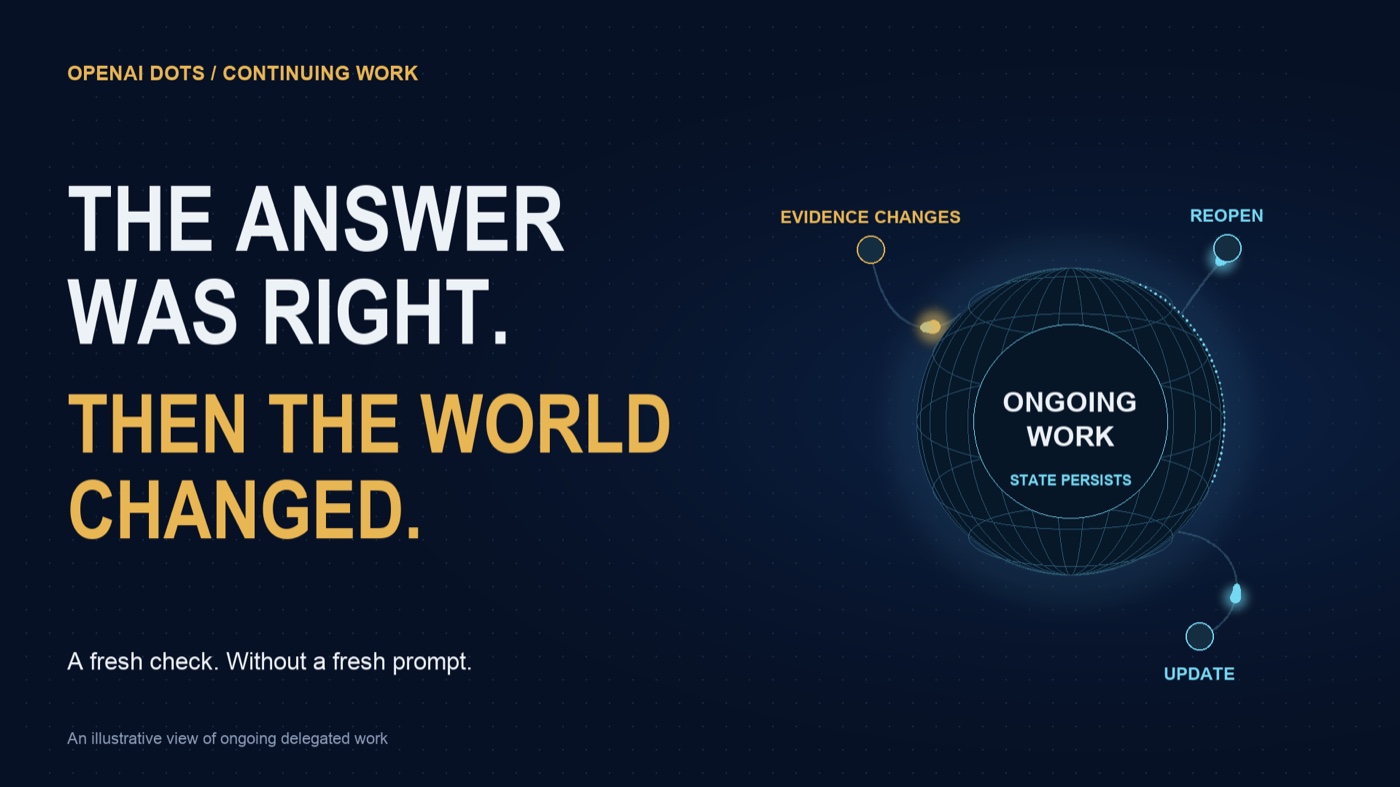
A good answer can become expensive when the world changes and nobody reopens it. Continuing delegation requires evidence, durable state, permissions and the ability to recognise when an old conclusion has stopped being safe to use.
Follow memory from how deep learning models learn to how AI racks and factories are built.
The original Micron earnings post connects the memory stack with the work AI systems are being built to do.
Micron’s customer commitments and funding arrangements put an earnings release in a different financing context.
Frontier model developers’ direct interest in memory tells us something about the increasingly integrated AI system.
Elon Musk, Jensen Huang and Gavin Baker discuss how useful intelligence per watt and better agent controls change infrastructure economics.
Pat Grady’s account connects changing capabilities, customer behaviour, compute constraints and AI financing.
Rebuilding a historical comparison with operating cash generation changes the conclusions it supports.
Consumer agents and coding show how lower marginal costs can broaden the work delegated—and the infrastructure needed to support it.
A strategic investor can earn through its own systems business as well as the shares it owns. That changes how to assess the investment.
A broad operating survey reveals how changing customers and workloads alter the economics of GPU cloud capacity.
A closer examination distinguishes a share-price response to yields from the actual financing sensitivity of the build-out.
An agent can both consume compute and help improve how it is used. Muse brings those two effects together.
Agent workflows bring memory’s role beyond a single response into sharper focus.
A working account of intelligence production, useful completed tasks, systems, financing and the route to economic returns.
Agents use a heterogeneous system: memory, accelerators, CPUs, networking and power. A market reaction focused on one component misses the system.
A September X post asked whether the habits acquired running deterministic systems make established banks slower to see how probabilistic AI changes software.
Optics investments and customer financing illustrate how NVIDIA funds dependencies its own growth needs.
Oracle reported $23.103bn of operating cash, including $11.363bn in specified customer prepayments. The money can pay for construction while the promised service is still outstanding.
John recommended Claus Aasholm’s essay on NVIDIA’s strategy. The analysis in the linked essay is Aasholm’s.
Dell counted over 6,500 AI Factory customers. Growth extended to traditional servers, networking and storage.
A live call note recorded the gap between Dell’s new outlook and its initial market reaction.
The August study found 149 recommendations and no defensible performance scores. The first tradable entry and a contemporaneous benchmark matter.
A response to a token-demand model replaced a simple per-seat cap with workers, agents, active hours, intensity and spawned work.
A follow-up separated Marvell’s nearer-term connectivity forecast from the longer-dated opportunity in custom chips.
The live call kept the scale of Marvell’s fiscal 2028 outlook in view while the share price repriced after hours.
A research system becomes more useful when it can retain the evidence, decisions and corrections that changed earlier conclusions.
IREN’s first 50MW Microsoft deployment separates a signed power figure from customer-accepted capacity that can earn revenue.
The follow-up shared a concrete deliverable produced with Grok Build on the split in AI infrastructure share prices.
An early field note recorded John’s experience using Grok Build for two real assignments.
NVIDIA’s investments and purchase commitments help determine which optical, power and compute capacity is available to its customers.
When a model can act, the economic question moves from the quality of an answer to the reliability and cost of completing the job.
John’s early-July thesis traced the economics of AI from a completed task through software, memory, compute, interconnect and power.
Cerebras supplied an early example of what low-latency decode can buy. The saving compounds along the steps of a serial AI workflow.
No publications match. Try another term or select all subjects.
A dated publication archive. Market prices, forecasts and company figures belong to the date of each piece. Posts have editorial labels for navigation; original links preserve the published wording and conversation. Articles reproduced here use the final publication copy, which may differ from subsequent edits on the original platform.